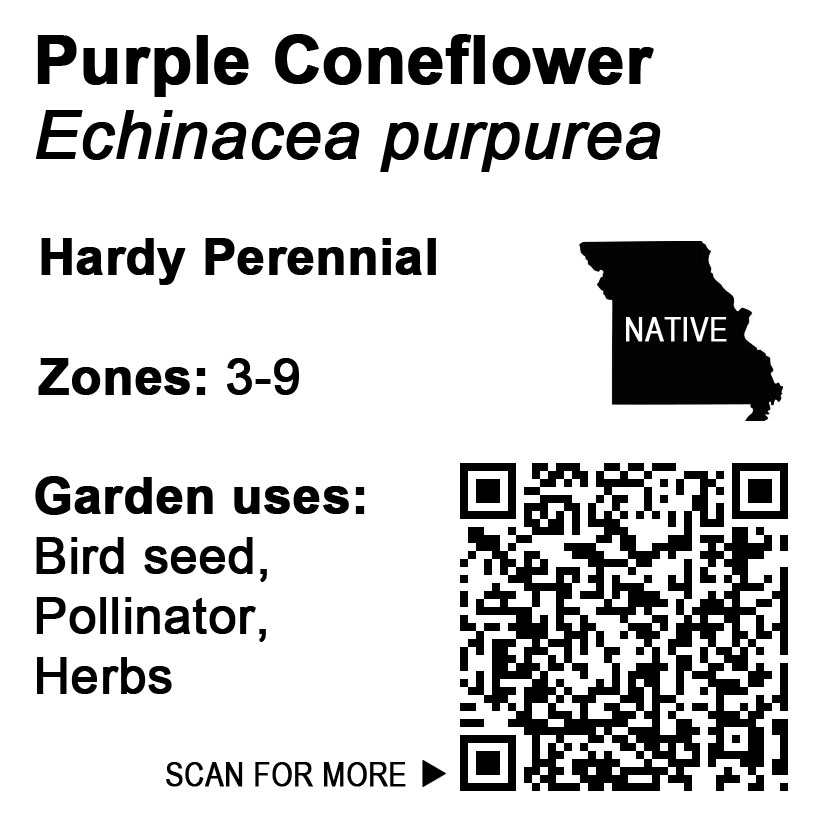
Welcome to a new series of plant profiles that will appear on my blog on an ongoing basis. These plant profiles are part of a project I’m working on for Thomas Dunn Learning Center, where I am volunteering work on the garden and grounds. I’m making informational tags for a number of plants on the grounds that already exist or that I’m introducing. Each tag will include a QR code that people can scan with their phones to get more information about the plants.
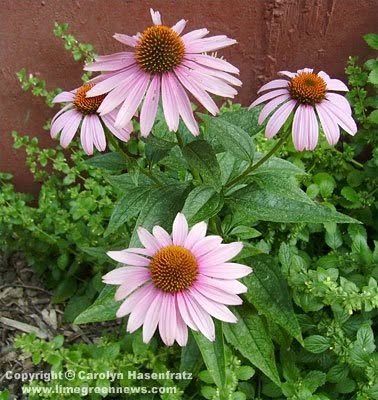
Purple Coneflower
Echinacea purpurea
Missouri native
Hardy perennial
Hardiness Zones: 3-9
Propagation: By seed, self sows, can also start indoors or out in spring. If starting from seed, make sure to cold stratify (Marcin 48).
Light: Full sun to part shade
Water requirements: Moist well-drained soil. Tolerates some drought once established.
Soil requirements: Average to poor – does not need fertilizer, except for possibly compost and rock phosphate in the spring (Kowalchik et al 177).
Care notes: May need staking. Divide every 3 or 4 years. You might get more flowers if you deadhead it, but some sources say deadheading is not required for rebloom (Genera Binder). In our case we want birds to be able to eat the seeds so we are leaving the seed heads in place.
Echinacea purpurea is an incredibly useful plant for wildlife and historically for human beings as well. The flowers make a nice sturdy platform for pollinating insects to get nectar and pollen. Small birds feed on the seeds. In Missouri it’s particularly common to see American Goldfinches (Carduelis tristis) enjoying the seeds.
Native Americans traditionally have used Purple Coneflower as medicine for a number of conditions, including sore throat, toothache, stomach ailments, and infections. It’s been eaten as a vegetable, used as a skin anesthetic and inhaled in smoke form for respiratory illnesses, headaches and depression (Kavasch and Barr 240-241). American settlers adopted its use for colds and flu (Oster 68). In the 1920s it was the most popular plant based drug in the US and was packaged and sold by drug companies, until more effective anti-infective medications were brought to the market (Kowalchik et al 176).
It’s still popular in the United States as well as in Europe (Kavasch and Barr 240).
Disclaimer: I want to explain the historic uses of herbs in order to generate interest in learning about plants and their properties, and the impact of plants on human culture. That doesn’t mean I endorse the use of herbs for medical conditions or am qualified to teach how to do it safely. This plant profile is not medical advice.
The name Echinacea is said to come from the Greek word “echinos” meaning “hedgehog”, a spiny animal (Genera Binder). Another source says the name derives from “Sea Urchin” (Art, A Garden of… 120). If you’ve ever worked around these plants you know how it feels to be poked by the dried flower centers and you know why it’s named after something spiny!
Garden uses: Bird seed, Pollinator, Herbs