Welcome to a new series of plant profiles that will appear on my blog on an ongoing basis. These plant profiles are part of a project I’m working on for Thomas Dunn Learning Center, where I am volunteering work on the garden and grounds. I’m making informational tags for a number of plants on the grounds that already exist or that I’m introducing. Each tag will include a QR code that people can scan with their phones to get more information about the plants.
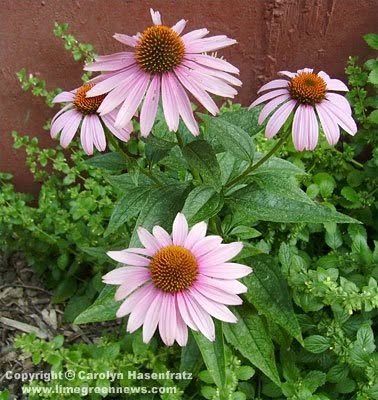
Purple Coneflower, Echinacea purpurea
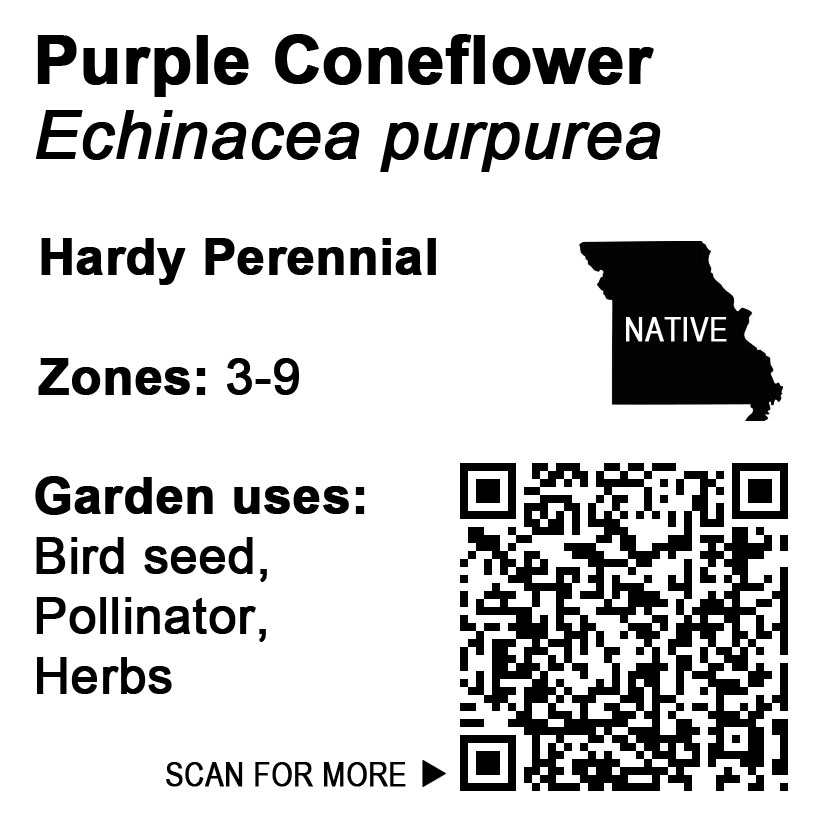
Purple Coneflower Echinacea purpurea
Missouri native
Hardy perennial
Hardiness Zones: 3-9
Propagation: By seed, self sows, can also start indoors or out in spring. If starting from seed, make sure to cold stratify (Marcin 48).
Light: Full sun to part shade
Water requirements: Moist well-drained soil. Tolerates some drought once established.
Soil requirements: Average to poor – does not need fertilizer, except for possibly compost and rock phosphate in the spring (Kowalchik et al 177).
Care notes: May need staking. Divide every 3 or 4 years. You might get more flowers if you deadhead it, but some sources say deadheading is not required for rebloom (Genera Binder). In our case we want birds to be able to eat the seeds so we are leaving the seed heads in place.
Echinacea purpurea is an incredibly useful plant for wildlife and historically for human beings as well. The flowers make a nice sturdy platform for pollinating insects to get nectar and pollen. Small birds feed on the seeds. In Missouri it’s particularly common to see American Goldfinches (Carduelis tristis) enjoying the seeds.
Native Americans traditionally have used Purple Coneflower as medicine for a number of conditions, including sore throat, toothache, stomach ailments, and infections. It’s been eaten as a vegetable, used as a skin anesthetic and inhaled in smoke form for respiratory illnesses, headaches and depression (Kavasch and Barr 240-241). American settlers adopted its use for colds and flu (Oster 68). In the 1920s it was the most popular plant based drug in the US and was packaged and sold by drug companies, until more effective anti-infective medications were brought to the market (Kowalchik et al 176).
It’s still popular in the United States as well as in Europe (Kavasch and Barr 240).
Disclaimer: I want to explain the historic uses of herbs in order to generate interest in learning about plants and their properties, and the impact of plants on human culture. That doesn’t mean I endorse the use of herbs for medical conditions or am qualified to teach how to do it safely. This plant profile is not medical advice.
The name Echinacea is said to come from the Greek word “echinos” meaning “hedgehog”, a spiny animal (Genera Binder). Another source says the name derives from “Sea Urchin” (Art, A Garden of… 120). If you’ve ever worked around these plants you know how it feels to be poked by the dried flower centers and you know why it’s named after something spiny!
Garden uses: Bird seed, Pollinator, Herbs
Here is the image that will be used on the plant tags.
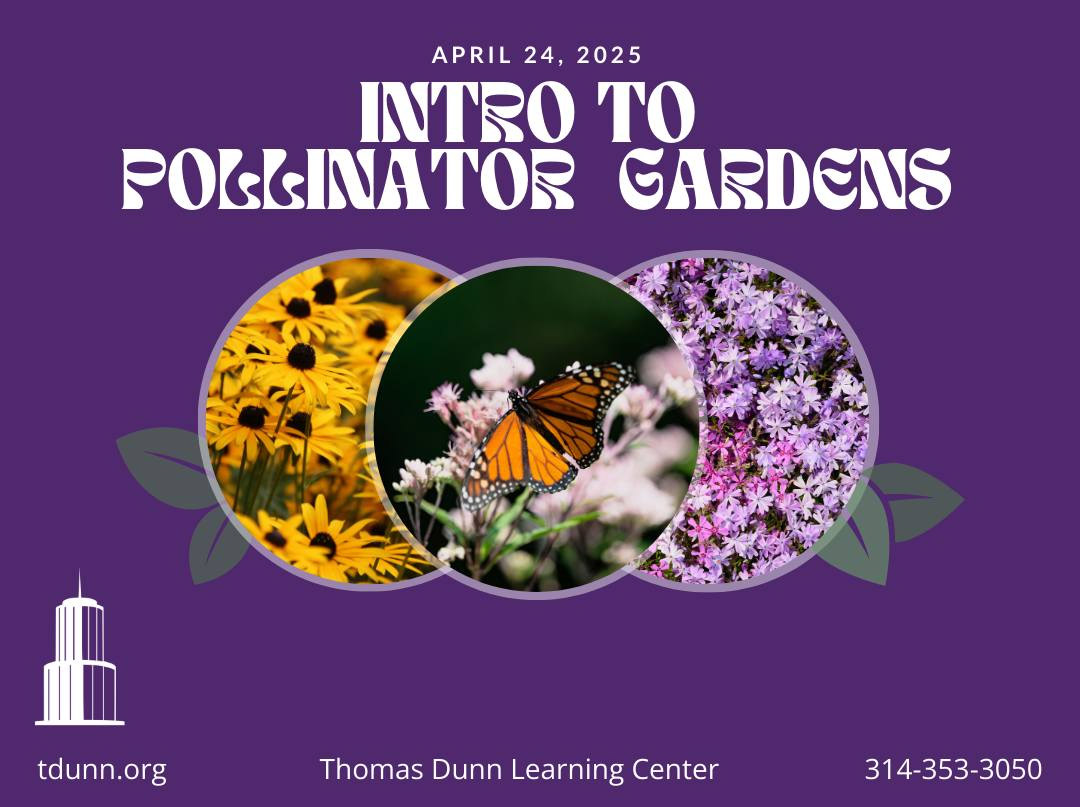
… is a presentation I’m giving tonight at Thomas Dunn Learning Center.
Following is the text on the handout I’m giving out. It consists of links to get more information, my contact information, Works Cited and resources for learning more.
Schnarr’s Hardware Blog Planting Calendar https://schnarrsblog.com/calendar/ – I made this when I worked for Schnarr’s Hardware using data for the St. Louis are from the When to Plant App published by Mother Earth News. I don’t edit it any more but I set the planting times to reoccur every year for as long as the site lasts, I hope.
Bulletin, Missouri Botannical Garden. — “Garden With A Purpose.” Bulletin, Summer 2018, pp. 10-13. — “Nature for All. Nature Forever.” Bulletin, Spring 2025, pp. 6-12. — “Protecting Native Plant Species in Missouri.” Bulletin, Summer 2018, p. 6. — “Restoring Nature.” Bulletin, Winter 2017-2018, pp. 14-15.
Burton, Robert and Stephen W. Kress. The Audubon Backyard Birdwatcher. Thunder Bay Press, 1999.
Conservation Federation. — Eagan, Elizabeth. “Royal Voyagers of the Sky.” Conservation Federation, May 2021, pp. 34-35. — Jenkins, Jason. “All Efforts Great and Small.” Conservation Federation, July 2017, p. 40. — Missouri State Parks. “State Parks Encourage Pollinator Populations.” Conservation Federation, July 2017, pp. 50-51. — Nemecek, Mary. “Missouri Native Bees: Important Pollinators.” Conservation Federation, July 2017, pp. 42-43.
Feltwell, John. The Naturalists Garden. Templar Publishing, 1987.
Houdret, Jessica. Practical Herb Garden: A comprehensive A-Z directory and gardener’s guide to growing herbs successfully. Hermes House, 1999, 2003.
Marlos, Daniel (Bugman). WhatsThatBug.com, 2024, whatsthatbug.com. Accessed 22 April, 2025.
Missouri Conservationist. — Archer, Larry. “Prairie on the Patio.” Missouri Conservationist, February 2024, pp. 16-21. — “Ask MDC.” Missouri Conservationist, March 2025, p. 7. — “Ask MDC.” Missouri Conservationist, January 2021, p. 6. — “Ask MDC.” Missouri Conservationist, July 2018, p. 6. — “Ask MDC.” Missouri Conservationist, July 2020, p. 6. — “Ask MDC.” Missouri Conservationist, September 2017, p. 7. — Briggler, Malissa. “Violets of Missouri.” Missouri Conservationist, March 2025, pp. 16-21. — Brunette, Lisa. “Garden of Eatin’.” Missouri Conservationist, April 2025, pp. 16-21. — Buback, Steve and Alex Morphew. “Chasing the Buzz.” Missouri Conservationist, February 2024, pp. 10-15. — Chasteen, Bonnie. “Insects in Need.” Missouri Conservationist, May 2021, pp. 22-27. — Chasteen, Bonnie. “Mead’s Milkweed Recovery”. Missouri Conservationist, July 2021, p. 4. — Dentner, Holly. “1 Bought Native Plants… Now What?” Missouri Conservationist, September 2022, pp. 10-16. — “Get Outside in April.” Missouri Conservationist, April 2025, pp. 22-27. — “Get Outside in January.” Missouri Conservationist, January 2025, p. 4. — “Get Outside in June.” Missouri Conservationist, June 2024, pp. 28-29. — “Missouri’s Least Wanted.” Missouri Conservationist, April 2020, p. 8. — Paothong, Noppadol, “Black Swallowtail Butterflies.” Missouri Conservationist, June 2018, pp. 10-17. — Paothong, Noppadol, “From Big-Eyed to Beautiful.” Missouri Conservationist, July 2020, pp. 10-21. — Paothong, Noppadol. “Giant Swallowtail Approaches Prairie Blazing Star.” Missouri Conservationist, June 2024, p. 25. — Paothong, Noppadol. “Hummingbird.” Missouri Conservationist, February 2020, p. 11. — Paothong, Noppadol. “Spring Beauty.” Missouri Conservationist, March 2025, p. 26. — Paothong, Noppadol and Chris Barnhart. “Regal Fritallary: Tending to the Queen of the Prairie.” Missouri Conservationist, March 2025, pp. 17-27. — Seek, Matt. “The Butterfly Effect.” Missouri Conservationist, September 2017, pp. 10-16. — “The Birds and the Bees.” Missouri Conservationist, February 2020, pp. 10-27. — “The Mints: Fresh Breath for Pollinators.” Missouri Conservationist, March 2024, pp. 28-29. — Van Dien, Dianne. “Marvelous Mosses.” Missouri Conservationist, April 2025, pp. 22-27. — Van Dien, Dianne. “Nature’s Monetary Ripples.” Missouri Conservationist, January 2025, p. 4. — “Wild Guide.” Missouri Conservationist, April 2025, p. 32. — Zarlenga, Dan. “Spreading Life in the Darkness.” Missouri Conservationist, May 2020, pp. 10-15.
The Gateway Gardener. — “Bird/Plant Matchmaker.” Gateway Gardener, October 2017, p. 17. — Woodbury, Scott. “A Spoonful of Sugar May Help the Honeysuckle Go Down.” Gateway Gardener, October 2017, p. 18. — Woodbury, Scott. “Gardens with Environmental Benefits.” Gateway Gardener, Summer 2020, pp. 10-11. — Woodbury, Scott. “Wild Vines I Have Loved.” Gateway Gardener, Winter 23-24, pp. 12-13