Category Archives: Conservation

Baby Bird Rescue 2014

Normally when I find a nestling baby bird on the ground, I take it to a wild bird rehabber. In 2009 three baby birds fell out of my neighbor’s dryer vent that I had to deal with differently – they were starlings. I knew what species they were and exactly when they were hatched because from my desk I can see out the patio door. On the building adjacent to my condo there is a little ledge that the starlings use as a staging area where they land before entering the dryer vent. That landing area is in direct view of where I sit while I work. It’s lucky for these birds I knew the species before I brought them in to a rehabber. Why is that? Many rehabbers will euthanize all starlings brought to them because they are not a native bird. They are believed by many to be destructive to other birds and are hated and persecuted by some people. By the time I called the wild bird rehab about my first batch of starlings, two of them had died – now that I know more about them I realize these two were never really healthy and they did not grow much before they died . When I spoke to the rehabber on the phone I was down to one bird and we had bonded with each other. I had been warned that the rehabber might want to euthanize my bird because I had done extensive reading on starlingtalk.com to learn how to care for them and I was made aware of how starlings are usually treated. The rehabber I spoke to seemed eager for me to keep it as a pet and I interpreted that as knowledge on her part that it would be euthanized and she knew it would be better off with me. I’m not 100% sure that my interpretation was correct but I did look on that organizations Facebook page a few days ago and looked through several years’ worth of photos of bird clients of theirs and there was not one starling picture. As common as they are it seems like there should be some if they rehab them, so I’m assuming they don’t. There is another bird rescue organization in the area that deals with raptors and larger birds and they sometimes feed starlings to their clients so I know not to take any there!
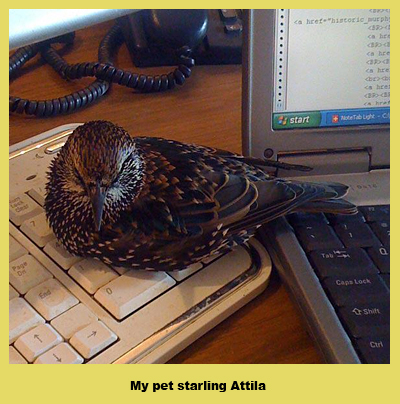
So I kept the surviving bird and named her Attila because of her rapacious appetite and we’ve been living happily together ever since. I adopted Pooky in 2011 at the age of three months old and with two starlings to compare to each other I realized Attila is female and Pooky is male. Living with two starlings is delightful in many ways – they are great talkers with a huge vocabulary of human words and phrases as well as environmental sounds and songs I’ve whistled to them mixed with crazy bird noises. They are very affectionate. Often when I’m working at my computer they are out of the cage and climbing on me and if they are in the right mood sleeping on my arm, snuggling against my neck, or in Pooky’s case sitting on my chest or in the crook of my elbow getting petted (Attila doesn’t like to be touched). They are easy to train and with their intelligence, curiosity and rather imperious attitude they are always surprising me and making me laugh with their antics. Starlings are not suitable for people who want a low-maintenance pet. It takes some adjustments in lifestyle to live with one – you can read about the requirements here – Is a Starling Right For You?

I woke up this past Mother’s Day, May 11, 2014 (coincidentally also Attila’s hatch day) not feeling very good because my mother died in 2010 and I had no mothers or grandmothers to go visit. Usually the first thing I do upon waking on a spring morning is open the patio door and look out over the back garden. I’d been watching the starlings nesting in the dryer vent with interest for a week now and enjoying the sounds of the babies calling out. Over the winter I had sent an email to the condo association office to remind them that it would be a good time to block that dryer vent before there was a nest in there again, but nothing was done so the starlings were back. It’s not that I object to the starlings – I love them obviously, and I also love that they eat lawn grubs, Japanese Beetles and tent caterpillars. But I don’t want my neighbor to have a fire in his dryer vent and I don’t want more baby birds to fall out. Well on this morning most of the sounds were coming from the ground, so I went over there to investigate, and sure enough, in the same spot where I found Attila five years ago, there were three adorable one week old baby starlings on the ground.
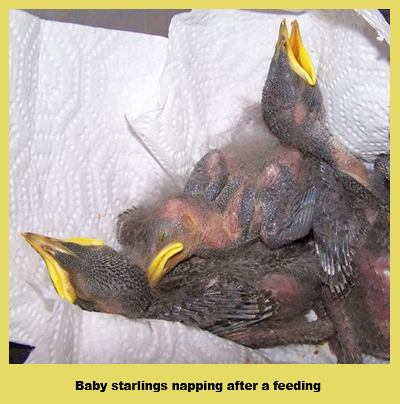
Normally the best thing to do is put them back in the nest, but I could not reach it – my stepladder is not tall enough. So I took them inside, made them a makeshift nest, fed them, and thought about what to do. Being foster mother to some baby birds on Mother’s Day was a great way to dispel the gloom of having no mother, but for how long? I knew that I now had the knowledge to raise them and take care of them, but could I handle having a total of five pet starlings? I know of people who have larger flocks of starlings than that in their house but they probably don’t live in condos with close neighbors who would not be thrilled with the noise. Attila is not very noisy but Pooky is quite loud at times and one Pooky is more than enough! Luckily neither bird is loud at night or early in the morning which is probably why my neighbors haven’t complained! Then there is the expense – it doesn’t cost much to feed them, but they get vet checkups once a year and for two birds it’s not that big of an expense but five? That’s several months electric bill! So that’s a no. Finding good homes for them would not be easy. It seemed like a better idea would be to try to build a nest box and get the parents to raise the babies in there.

So I looked online for starling nest box plans and called my Dad to see if he had enough wood on hand to build it. Dad is the handy type and has all the tools and usually sufficient supplies around for small projects like this. He said yes so I came over with the plans and he generously did most of the work. I could have done it but it probably would have taken me about four times as long and time was important in this case! I came home Sunday evening with a nice nest box. The next step was to call the condo association in the morning and get permission to place the box (they are very strict about what you can do on the outside of your unit) and to borrow a ladder to get the remaining starling baby out of the nest. It took about 24 hours to work through all the layers of bureaucracy but finally on Tuesday morning the head of maintenance and a helper came over and held the ladder while I climbed up to get the last baby out. It took the whole length of my arm plus a restaurant-style serving spoon but I barely managed to scoop it out. I put all four babies in the makeshift nest and put them in the box then tied the box to my stepladder and placed it near the dryer vent. The maintenance guy put a grid cover on the vent so they couldn’t get back in.
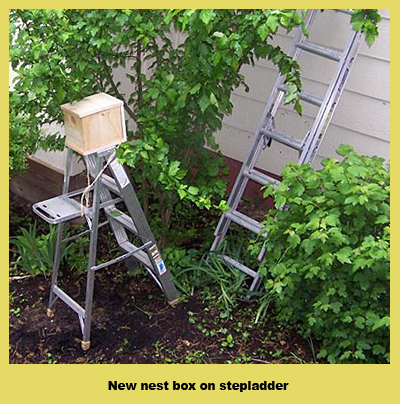
Now came some anxious waiting. By this time the babies had been with me 48 hours. They were already used to me feeding them – they would call out when I came near and their little heads would turn and look at me when I walked by – and accustomed to their new feeding schedule (once every 45 min on Sunday, once an hour on Monday). Believe it or not for the last two feedings on Monday evening they started making noise about a minute before my timer went off. Would they adjust back to being fed by the parents? And would the parents take them back? Several times the adult starlings approached the box with food without going in and I held my breath. Then finally success! After about three hours of steady feeding I declared the operation a success!

I’m writing this on Wednesday morning. I checked the babies first thing after waking up and they look fine and the parents are still frequently feeding them! They should be in the box for approximately another week and a half. Assuming no further disasters it will be a lot of fun to see them fledge! I don’t doubt that most people reading this probably think I’m out of my mind for spending this much effort on baby birds, and baby starlings at that. As far back as I can remember I’ve always been sympathetic to animals that other people don’t like especially if the disdain is for irrational reasons – insects, bats and snakes being prominent examples. Before starlings became my favorite bird, I was most fond of turkey vultures, considered ugly by some but beautiful to me. How much is a baby bird worth? Since I have intimate knowledge of what an adult starling is like, to me they are priceless!

For more information:
Fit and Healthy on Route 66 – Fort Bellefontaine County Park


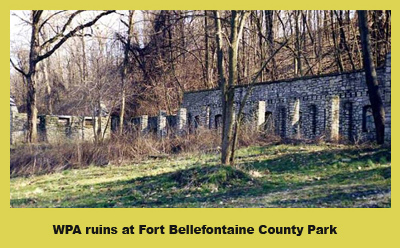
Fort Bellefontaine County Park on the banks of the Missouri River in North St. Louis County is one of my all-time favorite places for a hike. It’s more than just beautiful – it’s exciting and mysterious. History buffs will get a thrill here because in 1805 it was established as the first United States military fort west of the Mississippi and is the spot where the Lewis and Clark expedition camped on their first night heading west and on their last night of the return trip. The fort also played a role in the war of 1812 and was a trading post where Spanish, French and American traders did business with Native American tribes. The military moved to Jefferson Barracks in what is now South St. Louis County in 1826 and the Fort Bellefontaine site was later taken over by the City of St. Louis who established Bellefontaine Farms, later the Missouri Hills Home for Boys, on this spot. In the 1930s, there was a public beach here and the WPA built a Grand Staircase down the river bluff along with other stone structures intended to draw visitors to the area. The remains are quite a sight. At the top of the Grand Staircase a cannon is displayed. This bugs me because it gives the impression to the uninformed that the Grand Staircase is actually the fort, but unfortunately there are no remains of the fort to be seen. There is one small building on the site believed to be built from old fort foundations, but as far as I know all the other stone work you see here is from the 1930s.

I grew up in North St. Louis County and did not know of the existence of this place until the time of my first visit in 1990. Although the park was acquired by St. Louis County in 1986, as far as I know the only way to visit it in 1990 was by canoe – this is what I was told by my friend Rich, a fellow member of the St. Louis Community College at Florissant Valley Outdoor Club. He heard about it from the faculty mentor of our group, who was an avid canoeist and outdoorsman and knew about all kinds of interesting places to explore. Rich proposed that the two of us put a canoe in where Highway 367 meets the Missouri River, stop off to see the Grand Staircase, continue to the confluence of the Missouri and Mississippi Rivers and cross the Mississippi over to the Illinois side to visit the spot where Lewis and Clark began their trek to the Louisiana Territory and have a picnic lunch. Then we would continue down the Mississippi to pass under the Chain of Rocks Bridge and over the Chain of Rocks falls and take out at North Riverfront Park where we would leave a shuttle car. Canoeing or kayaking the Chain of Rocks falls is not something to be taken lightly even by very experienced paddlers. Fatal accidents are possible.


Well how could I say no to an action-packed itinerary like that? March 2, 1990 had fine weather for such an adventure and all went smoothly. I remember the date because it was one of the most exciting of my life! In the present day, the Missouri River shoreline has been cleared of brush immediately in front of the Grand Staircase but in 1990 that was not the case. After pulling the canoe up on the bank we had to bushwhack through the brush to get to the staircase – not that difficult to do in late winter when there were no leaves on the branches – it was fairly easy to see where to go. The first look at the Grand Staircase was not something to be forgotten and it was many more times as exciting as it might have been because we were not sure we were supposed to be there. We dared to climb the staircase to the top of the bluff and we saw some of the Missouri Hills Home for Boys Buildings. Most were in good repair but I remember one that was more of a moss-covered ruin and we watched snowmelt dripping from it in the bright sunshine with delight at the beauty of the architecture. A nearby stone gazebo still had some of the wood roof structure in place at that time.

I won’t go into detail about the rest of our awesome day except to mention that back in 1990, another thing that was very difficult to see except from a boat was the confluence of the Missouri and Mississippi Rivers. Now there are two public areas – Edward “Ted” and Pat Jones-Confluence Point State Park and Columbia Bottom Conservation Area – that give you access but at the time this area was private farmland.

In the second half of the 1990s, word began to get around that this was a park you could actually go to officially and it became a regular hiking spot for my family and I.


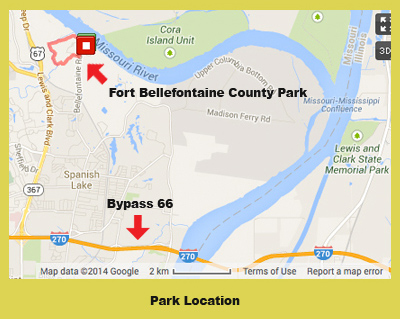
To visit the park, take the Bypass 66 Route westward from the Chain of Rocks Bridge and make a right on Bellefontaine Road and continue until it dead ends. There is a guard gate. Stop there and an attendant will write down your license number, get your name and issue you a parking pass. They usually know why you are there but if they ask just explain that you want to hike. There are a couple of parking spots you can choose, I like the one near the top of the bluff at the Grand Staircase. You will discover that there is a lot more to see than the Grand Staircase. At the base of the bluff is a hiking trail. If you take it to the left, you will follow the Missouri River upstream for a bit until you reach the spot where Coldwater Creek terminates in the Missouri River. Along this segment of the trail are a number of interesting ruins and information signs.

To see the end of Coldwater Creek is especially interesting to me because the creek is a major personal landmark. Where I grew up in Florissant, the creek passed close to our house and some of the best times of my childhood were spent on a wooded trail that ran parallel to the creek and linked two parks and a cemetery. It was not an official trail – the local kids wore it through there! My neighborhood friends and I had what we called our “hideout” which we used to furnish with rugs, drapery and a makeup table (!!??) in a tangle of small trees (which is still there!) near the creek in back of St. Ferdinand Cemetery. Sadly the trail is overgrown now and it’s hard to even see where it might have been, testament to the fact that kids don’t play there any more. Perhaps that’s for the best though. Creeks that function as storm drains are not really safe places for kids and Coldwater Creek, which originates near Lambert Airport, besides being known a huge source of fun for many North County kids, is also notorious for possibly being contaminated with toxic waste and there is suspicion that those who spent time in it or near it might be prone to diseases in adulthood.

The creek is certainly not devoid of life. I don’t know if it contains fish, but there were crawdads in it when I was young (which I used to try to catch of course with little success) and there are still crawdads in it now. It also supports fresh water clams. On a recent Fort Bellefontaine hike we found clam shells of all sizes including some almost as big as my hand! Small frogs are present and we saw evidence of predatory birds feeding on critters – large heron footprints in the mud and collections of excreted crawdad parts!


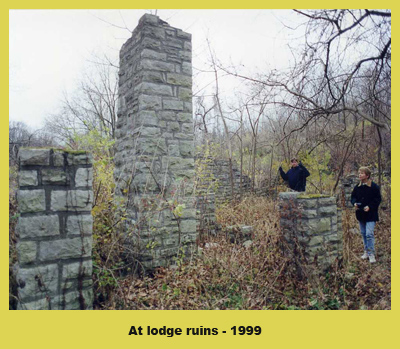
The trail follows the creek upstream where eventually you can see a very interesting ruin of a lodge which is starting to fall into the creek due to bank erosion. Shortly after this ruin the trail turns uphill. This is the only part of the trail that is at all challenging. After the short climb, the trail forks off. To the right it skirts a pond in an open grassy area. This part of the trail is new. If you take the trail left, this is the route we used to take when we first started hiking here. It takes you past a police dog cemetery and a police dog training area. You don’t see that every day!

Whichever fork you take around the pond, you will be led back to a trailhead at one of the main roads that passes through the youth facility. Follow one of those roads back to the bluff top and you’ll be back at the parking spot. There is a shorter segment of trail on the right, which I’ve only actually been on one time. On the way out, stop at the guard shack and turn in your parking pass and leave with great memories of a really unique place!

For more information:

Beneficial Insects in the Garden

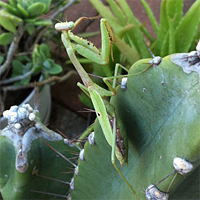
Are you interested in making your garden more habitable to beneficial insects? Here is a list of invertebrates you might want in your garden, followed by a chart showing what plants are likely to attract them and what plants may repel pests.

Read more:

http://www.limegreennews.com/beneficial_insects.html