Category Archives: Gardening

Unfinished Compost: Garden Diary – February 7, 2015

It’s late winter here in the St. Louis, Missouri area and we’re having an unseasonably warm weekend – not that I’m complaining! This is a good opportunity to look over my garden while the ground is relatively bare and make plans for the coming year.

Every garden has it’s own challenges – I started my current garden in January of 2005. My main goals for this project were to grow some culinary herbs and do my part for the environment by managing my garden to benefit wildlife and have a positive impact on the local water, air and soil quality. When I started the only plant growing in my garden was liriope – a nice plant but not that interesting by itself. I have made a lot of progress. I have found a number of plants that will grow in my part shade conditions. I have built raised beds filled with imported soil, sand and masses of organic matter over the mixture of clay and construction debris that passed for soil before I started. I have excavated buckets full of bricks and other debris. I have installed connected soaker hoses under all the beds to make watering easier and less wasteful. I don’t have all native plants but I have planted some as food for native wildlife. I have attracted a population of birds and beneficial insects that do nearly all of the pest control for me. Japanese Beetles and Eastern Tent Caterpillars are no longer a major plague on the flowering trees outside my bedroom as they were when I first moved here.

There is still a lot of room for improvement. I live in a condominium and I’m fortunate that the condo owners’ association lets me garden at all. My unit is on the ground floor and on the end, so I’ve claimed three sides of that end of the building for my garden which gives me quite a bit of linear space. I’ve let my near neighbors know that they can garden there if they want because I don’t own the space, it’s common ground, but none are interested so for now that’s my garden. I imagine most people live in condos because they don’t want to bother with yard work and things like that, but some of us in the condo complex do garden, we even had a garden club for awhile. I’d much rather work on a garden – for me it’s a hobby – than maintain lawns or shovel snow so I’m happy to let others do the maintenance type things outside while I do the creative stuff! My gardening style is different from how most of the rest of the condo complex is managed. I prefer the permaculture way of management. I like to plant mostly perennials and leave them standing until late winter for wildlife habitat and food, while the landscaping company employed by the condo complex likes to plant a lot of annuals and leave large patches of ground bare in the winter. I don’t think they object to what I’m trying to accomplish, the property managers seem to be wildlife friendly, but it’s taken some time to get them to understand what I’m doing. Wildflowers, native plants and herbs look unusual if everyone else in the vicinity is growing hostas, begonias and impatiens, I understand that.

One of the major problems my garden has is that it looks sloppy in winter. Having a garden that looks good all year in a continental climate is really difficult even when you have complete control over your space. I think leaving perennials stand in winter is much more attractive than bare ground, and the local birds benefit from the resulting cover and food. This practice is good for the health of the garden also – it keeps soil from washing away, helps maintain the fungi, bacteria and tiny animals that keep soil healthy, provides shelter for new seedlings to increase the number of plants available and the standing plants serve as overwintering places for beneficial insects. Unfortunately when the landscapers come by with their leaf blowers, the standing plants (if they are still standing) end up looking bedraggled and beaten up and a lot of the mulch I put down gets blown away. Some of this mulch ends up in the grass which does not help the already struggling lawn. By far the best thing for my garden would be for the leaves in my garden to be left alone – I’d have less dieoff of plants over the winter and the soil would be much healthier both for my own plants and surrounding trees in the lawn – but I don’t know what my chances are of persuading the management go along with that. I do have a proposal that I’m going to run by them for leaf management in my garden next fall and it remains to be seen if they’ll go for it. In the meantime, how can I make my garden look neater?

One problem area is the ground around my Rose of Sharon (Hibiscus syriacus) bush. If you have one of these plants, you know they are very prolific seeders. There are positive aspects to this – I’ve observed three species of birds eating the seeds and the abundant flowers attract masses of bees, butterflies and hummingbirds – but you do have to keep up with the extra seedlings! I’ve been unsuccessful so far in getting much else besides Rose of Sharon seedlings to grow under there so for now I’m going to put down some cardboard, paper, and other biodegradable barriers to kill off last year’s seedlings, add a layer of dirt, and mulch the heck out of it so it’s not unsightly. This is my favorite method of weed control – much better than poisoning the ground! There are a few Blackberry lilies hanging on somehow there and if my memory is correct some irises also so I’ll go around those so they don’t get smothered.
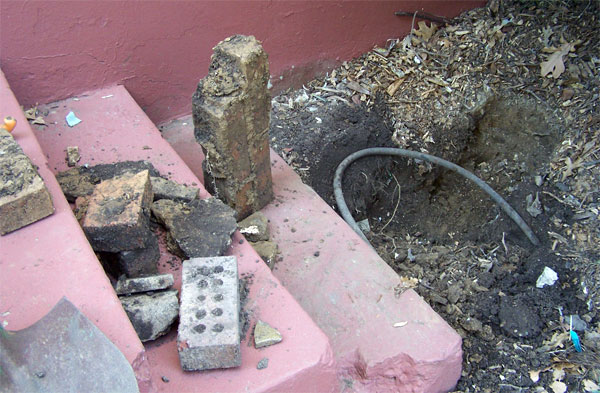
My "dirt mine" - also a brick mine!
My “dirt mine”, with temporarily unburied section of soaker hose – also a brick mine!

This task ended up consuming much of the day – one reason is that my source for the dirt was to dig a large hole in an area I use for a “dirt mine”. I needed a lot of dirt so I dug the hole bigger than I ever have before and as a result ran into a lot of construction debris which took some time to dig out of the heavy clay. This is not all bad – free bricks are handy for shoring up raised beds and I think I have a plan for the large flat rocks! Stay tuned for the next garden improvement!
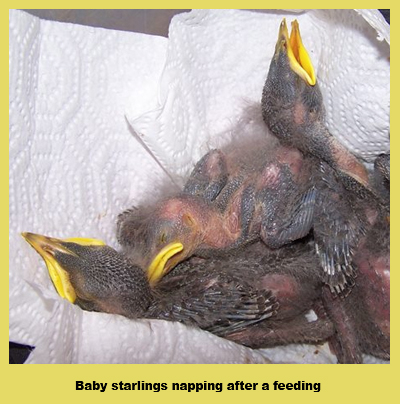
Baby Bird Rescue 2014

Normally when I find a nestling baby bird on the ground, I take it to a wild bird rehabber. In 2009 three baby birds fell out of my neighbor’s dryer vent that I had to deal with differently – they were starlings. I knew what species they were and exactly when they were hatched because from my desk I can see out the patio door. On the building adjacent to my condo there is a little ledge that the starlings use as a staging area where they land before entering the dryer vent. That landing area is in direct view of where I sit while I work. It’s lucky for these birds I knew the species before I brought them in to a rehabber. Why is that? Many rehabbers will euthanize all starlings brought to them because they are not a native bird. They are believed by many to be destructive to other birds and are hated and persecuted by some people. By the time I called the wild bird rehab about my first batch of starlings, two of them had died – now that I know more about them I realize these two were never really healthy and they did not grow much before they died . When I spoke to the rehabber on the phone I was down to one bird and we had bonded with each other. I had been warned that the rehabber might want to euthanize my bird because I had done extensive reading on starlingtalk.com to learn how to care for them and I was made aware of how starlings are usually treated. The rehabber I spoke to seemed eager for me to keep it as a pet and I interpreted that as knowledge on her part that it would be euthanized and she knew it would be better off with me. I’m not 100% sure that my interpretation was correct but I did look on that organizations Facebook page a few days ago and looked through several years’ worth of photos of bird clients of theirs and there was not one starling picture. As common as they are it seems like there should be some if they rehab them, so I’m assuming they don’t. There is another bird rescue organization in the area that deals with raptors and larger birds and they sometimes feed starlings to their clients so I know not to take any there!

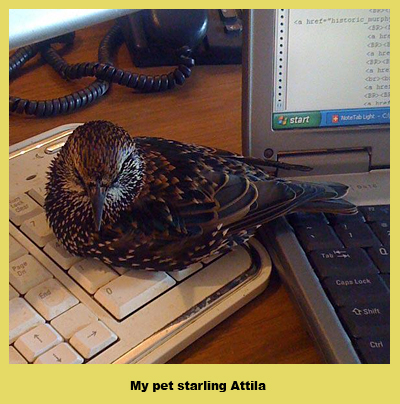
So I kept the surviving bird and named her Attila because of her rapacious appetite and we’ve been living happily together ever since. I adopted Pooky in 2011 at the age of three months old and with two starlings to compare to each other I realized Attila is female and Pooky is male. Living with two starlings is delightful in many ways – they are great talkers with a huge vocabulary of human words and phrases as well as environmental sounds and songs I’ve whistled to them mixed with crazy bird noises. They are very affectionate. Often when I’m working at my computer they are out of the cage and climbing on me and if they are in the right mood sleeping on my arm, snuggling against my neck, or in Pooky’s case sitting on my chest or in the crook of my elbow getting petted (Attila doesn’t like to be touched). They are easy to train and with their intelligence, curiosity and rather imperious attitude they are always surprising me and making me laugh with their antics. Starlings are not suitable for people who want a low-maintenance pet. It takes some adjustments in lifestyle to live with one – you can read about the requirements here – Is a Starling Right For You?

I woke up this past Mother’s Day, May 11, 2014 (coincidentally also Attila’s hatch day) not feeling very good because my mother died in 2010 and I had no mothers or grandmothers to go visit. Usually the first thing I do upon waking on a spring morning is open the patio door and look out over the back garden. I’d been watching the starlings nesting in the dryer vent with interest for a week now and enjoying the sounds of the babies calling out. Over the winter I had sent an email to the condo association office to remind them that it would be a good time to block that dryer vent before there was a nest in there again, but nothing was done so the starlings were back. It’s not that I object to the starlings – I love them obviously, and I also love that they eat lawn grubs, Japanese Beetles and tent caterpillars. But I don’t want my neighbor to have a fire in his dryer vent and I don’t want more baby birds to fall out. Well on this morning most of the sounds were coming from the ground, so I went over there to investigate, and sure enough, in the same spot where I found Attila five years ago, there were three adorable one week old baby starlings on the ground.

Normally the best thing to do is put them back in the nest, but I could not reach it – my stepladder is not tall enough. So I took them inside, made them a makeshift nest, fed them, and thought about what to do. Being foster mother to some baby birds on Mother’s Day was a great way to dispel the gloom of having no mother, but for how long? I knew that I now had the knowledge to raise them and take care of them, but could I handle having a total of five pet starlings? I know of people who have larger flocks of starlings than that in their house but they probably don’t live in condos with close neighbors who would not be thrilled with the noise. Attila is not very noisy but Pooky is quite loud at times and one Pooky is more than enough! Luckily neither bird is loud at night or early in the morning which is probably why my neighbors haven’t complained! Then there is the expense – it doesn’t cost much to feed them, but they get vet checkups once a year and for two birds it’s not that big of an expense but five? That’s several months electric bill! So that’s a no. Finding good homes for them would not be easy. It seemed like a better idea would be to try to build a nest box and get the parents to raise the babies in there.

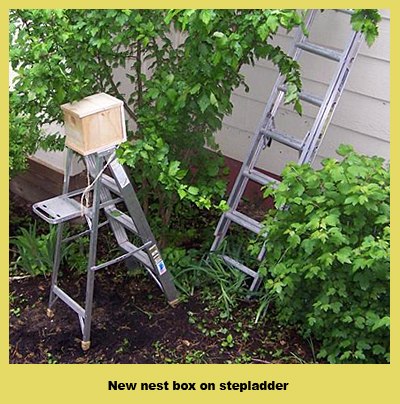
So I looked online for starling nest box plans and called my Dad to see if he had enough wood on hand to build it. Dad is the handy type and has all the tools and usually sufficient supplies around for small projects like this. He said yes so I came over with the plans and he generously did most of the work. I could have done it but it probably would have taken me about four times as long and time was important in this case! I came home Sunday evening with a nice nest box. The next step was to call the condo association in the morning and get permission to place the box (they are very strict about what you can do on the outside of your unit) and to borrow a ladder to get the remaining starling baby out of the nest. It took about 24 hours to work through all the layers of bureaucracy but finally on Tuesday morning the head of maintenance and a helper came over and held the ladder while I climbed up to get the last baby out. It took the whole length of my arm plus a restaurant-style serving spoon but I barely managed to scoop it out. I put all four babies in the makeshift nest and put them in the box then tied the box to my stepladder and placed it near the dryer vent. The maintenance guy put a grid cover on the vent so they couldn’t get back in.

Now came some anxious waiting. By this time the babies had been with me 48 hours. They were already used to me feeding them – they would call out when I came near and their little heads would turn and look at me when I walked by – and accustomed to their new feeding schedule (once every 45 min on Sunday, once an hour on Monday). Believe it or not for the last two feedings on Monday evening they started making noise about a minute before my timer went off. Would they adjust back to being fed by the parents? And would the parents take them back? Several times the adult starlings approached the box with food without going in and I held my breath. Then finally success! After about three hours of steady feeding I declared the operation a success!

I’m writing this on Wednesday morning. I checked the babies first thing after waking up and they look fine and the parents are still frequently feeding them! They should be in the box for approximately another week and a half. Assuming no further disasters it will be a lot of fun to see them fledge! I don’t doubt that most people reading this probably think I’m out of my mind for spending this much effort on baby birds, and baby starlings at that. As far back as I can remember I’ve always been sympathetic to animals that other people don’t like especially if the disdain is for irrational reasons – insects, bats and snakes being prominent examples. Before starlings became my favorite bird, I was most fond of turkey vultures, considered ugly by some but beautiful to me. How much is a baby bird worth? Since I have intimate knowledge of what an adult starling is like, to me they are priceless!

For more information:

Beneficial Insects in the Garden

Are you interested in making your garden more habitable to beneficial insects? Here is a list of invertebrates you might want in your garden, followed by a chart showing what plants are likely to attract them and what plants may repel pests.

Read more:

http://www.limegreennews.com/beneficial_insects.html