Holiday party centerpiece made with donated and natural materials
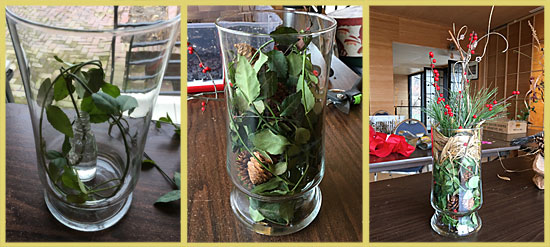
Litzinger Road Ecology Center has an annual Holiday party for volunteers. I wasn’t able to go because I went to the Master Gardener party instead which was the same day. I did however get to participate in the fun of making centerpieces from natural materials and donated flower arranging supplies.
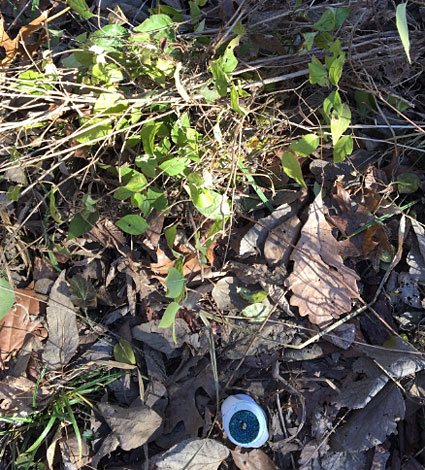
Invasive Honeysuckle at Litzinger Road Ecology Center
Although Honeysuckle can be a lovely plant, many species can be invasive and destructive. If you want to rid your property of invasive Honeysuckle, I wrote an article on how to do it.
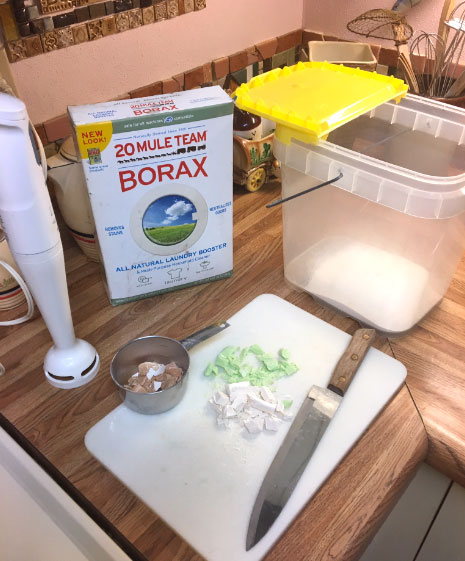
When a bar of soap gets worn down and is near the end of its usefulness, it’s considerably less appealing than when it was new. The scent has faded, it’s brittle or soggy – time to throw it out, right? Do you have some soap bars you don’t like? Do you have a collection of little motel soaps that you don’t know what to do with? You could throw these soaps out, but I prefer to save up my soap scraps and make them into laundry soap.
This is the time of year when small lakes, ponds and water gardens sometimes get green “pea soup” water or mats of algae floating on the surface. The limiting factors for algae growth are mainly food and sunlight. If you can reduce the amount of sunlight and nutrients getting into the water, you can reduce algae growth in your water feature.
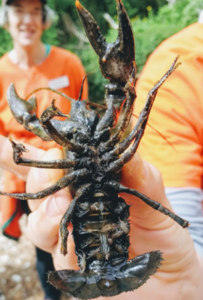
I used my childhood crawdad catching skills to hand-catch the most “Macro” invertebrate of the day – a large mother crawdad with tiny babies clinging to the underside of her tail. We released all the animals back into the water after we had a look at them.
Aquatic Macro Invertebrates are animals without a backbone that live in water and can be seen with the naked eye. I’ve had an interest in these creatures ever since I can remember. When I was young I caught a variety of water invertebrates such as water beetles, clams, crawdads and snails and attempted to maintain them in my aquariums. I was thrilled when my brother’s aquarium started to grow hydra even though they predate on tiny fish, because I’d read about them but never thought I’d see any. I currently have small colonies of freshwater shrimp in three of my aquariums. Many aquatic invertebrates are insects that live part of their life cycles in water but have an adult flying stage.
When the Litzinger Road Ecology Center offered a training workshop for volunteers on how Aquatic Macro Invertebrates are used to monitor water quality, of course I had to attend. Master Naturalist and Stream Team member Cliff Parmer taught us some Aquatic Entomology facts then we went outside to Deer Creek to learn how to take a scientific sample of water invertebrates.
The Metropolitan Sewer District has been working hard on outreach to inform the public about Project Clear. In their own words, Project Clear is the “planning, design and construction of MSD’s initiative to improve water quality and alleviate many wastewater concerns in the St. Louis region.” MSD operates in both St. Louis City and County.
What are some examples of wastewater concerns in our region? Flooding, erosion, water pollution and sewer backups are some issues that affect many of our neighbors if not ourselves. MSD deals with both stormwater, which is intended to discharge directly into the natural environment, and wastewater, which needs to be treated at a wastewater treatment plant before release. MSD is undertaking large scale projects right now that are estimated to take 23 years to complete.
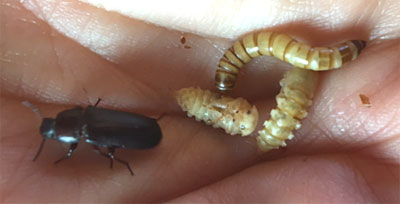
Life stages of the mealworm beetle in my hand – one larva, two pupae and one adult
Late winter and early spring are good seasons to attract desirable bird species to your yard. Birds are not brooding eggs yet because they need to wait until later in spring when there is enough insect food to feed their young. However, they are now engaged in, well, getting engaged! In other words many birds are scouting out nest sites and selecting mates if they haven’t done that already. Some of the most sought-after backyard bird species are heavy insect eaters. Raising live mealworms is so easy, I started by accident!
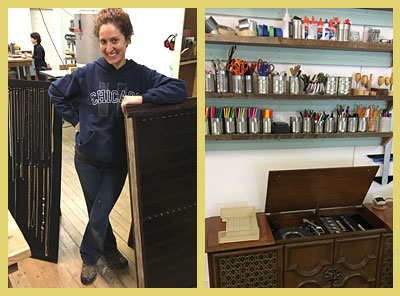
Mary with two of her jewelry display boards that she built
Perennial is a non-profit community workshop and store with the mission of building a creative culture of sustainability and turning discarded items into valuable resources. As an artist and craftsperson who already is enthusiastic about using recycled materials, I was delighted when my friend Mary (pictured at top left) invited me to meet her there and try out one of the community workshop sessions.
I met Mary at a Creative Arts Fellowship last year and got to know her better at some subsequent events. Mary’s art and mine have a lot in common – we both like upcyling materials and taking apart old jewelry to make new. I enjoyed teaching a class with Mary recently at one of her Women’s Upcycled Jewelry Jams. I’m looking forward to more opportunities for Mary and I to collaborate. A gifted artist and teacher, Mary creates under the name Sanctified Studios.
I knew I’d love Perennial after being in there for about two minutes! Seeing all the nice work space, supplies and tools was exciting but what really sold me was the console stereo! Clearly my retro-loving, thrift-shopping, dumpster-diving self was going to feel comfortable here.
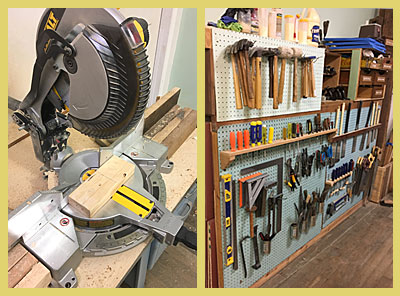
Look at all those wonderful woodworking tools!
At my first work session I cut up some wood for an upcoming class I’m going to be teaching on building garden pollinator houses. Then I put together a wood tray that I’ll be finishing and writing about later.
You can become a member of Perennial to access the work space and use the tools when they hold open sessions. Different levels of membership also give you discounts on classes and other events. Perennial accepts donations of materials. You can trade or purchase some of the materials for what you think is a fair market value. They also make craft kits that are for sale in the shop.
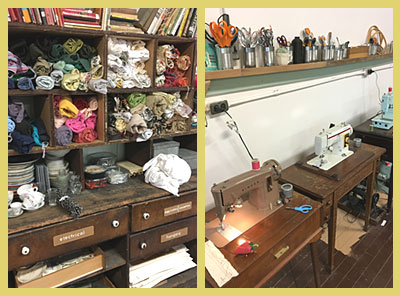
Some of the supply stash on the left and the sewing area on the right.
Art and crafting can often be lonely activities. Working around other artists is really healthy for social interaction and for the stimulation of being around new ideas. I’m looking forward to many happy times while I enjoy my new membership!
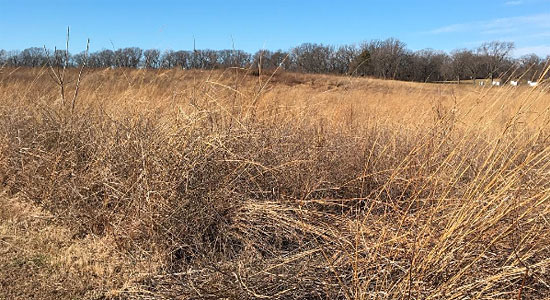
I’m a volunteer at the Litzinger Road Ecology Center in Ladue. Volunteers and on some occasions the public are invited to educational events on the premises. I recently attended a session for volunteers to learn about why the prairie sections at the center are periodically burned and an introduction about how to start a fire, control the fire, and perform the burn safely.
The Lower Meramec River, which runs from Sullivan, MO to the Mississippi River, is not one of the most popular sections to paddle. If you enjoy lake paddling or exploring large rivers, you might want to take another look at the Lower Meramec. I paddled two sections recently and enjoyed it tremendously.
On August 27, 2016 I joined some other volunteers to participate in Operation Clean Stream, sponsored by the Open Space Council. On this day there were several locations we could pick from. I brought my own kayak this time so I chose a route that was not serviced by an outfitter.
I checked in at Castlewood State Park in Wildwood and met a great group of people at the put-in point on the beach. This fun and hard-working group of volunteers and I headed downstream toward our eventual takeout point at Green Tree Park in Kirkwood.
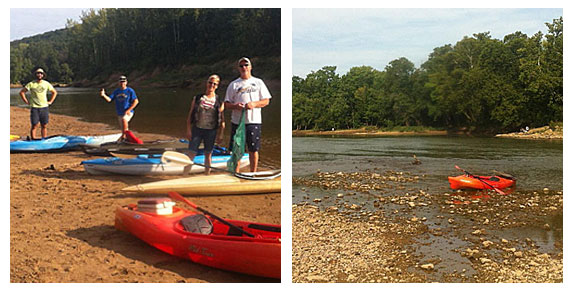
At the left is my group getting ready to depart from the Castlewood State Park boat ramp. On the right is a sandbar where we stopped to clean up trash. On the shore you can see a couple of land volunteers.
At one point I had to paddle upstream for awhile to go back to that sandbar because I thought I had lost an item there. It turned out I hadn’t lost it but I did learn one thing – it’s pretty easy to paddle upstream (perhaps up to Route 66 State Park?) so it’s possible to go for a solo paddling outing from here without worrying about a shuttle. Just paddle upstream for awhile then downstream again to get back to your vehicle.
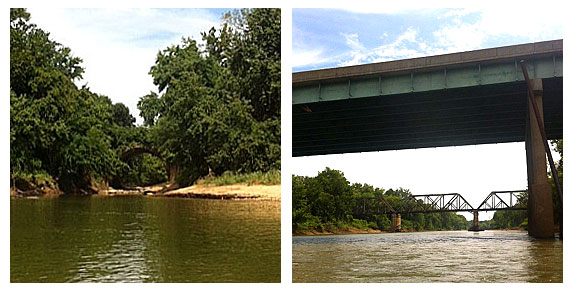
On the left is an interesting bridge that appears to have vegetation growing on top. It’s right before the Hwy. 141 bridge. On the right is the 141 bridge and a railroad bridge just beyond it.
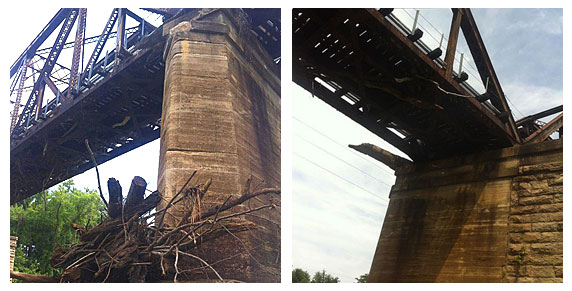
Taking photos like those above could be hazardous to your safety if you are not careful! The current is pretty swift here so I probably should have concentrated on steering the kayak. It was pretty awesome to see all the logs stuck in and on the bridge from the Flood of 2015 which was of historic proportions – can you believe the water got that high? This bridge is not far from Simpson Lake, where I participated in flood cleanup in February.
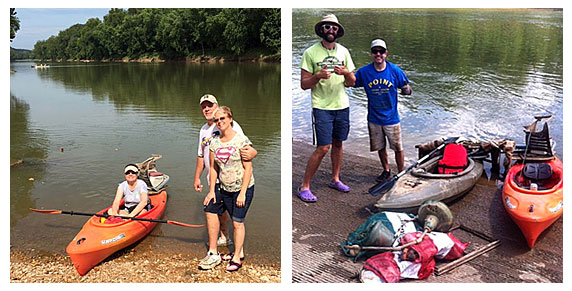
I’m pictured at the left with Eric and Kim. On the right are Simon and Tim at the takeout point at Greentree Park, displaying part of our haul. It’s only about a six mile float from Castlewood State Park to Greentree, but it took us a good part of the day because we stopped a lot for trash. Trying to retrieve trash from a boat in a current will really test your paddling skills – you have to be able to maneuver in and out of tight spots, enter and exit frequently without tipping, be able to approach and dock alongside obstacles safely and have a good idea how far over you can lean to grab something. You’ll exercise different parts of your body than you’re used to – a great workout!